Mastering Remote Work Culture in Global Teams
Ten timezones, seven years, one rule: if it isn't written down, it didn't happen. A field guide to async-first work.
TL;DR5
- Async-first is a discipline, not a tool: every decision gets a written artifact within 24 hours
- Write issues and RFCs so a teammate 12 hours away can act without asking a single clarifying question
- Meetings are exceptions with an agenda, a decision, and a recording — never a default
- Remote-first beats remote-friendly: design processes for distance, not for the office with remotes bolted on
- Loneliness is the real churn risk; fix it with rituals, not perks
Beyond Zoom Calls
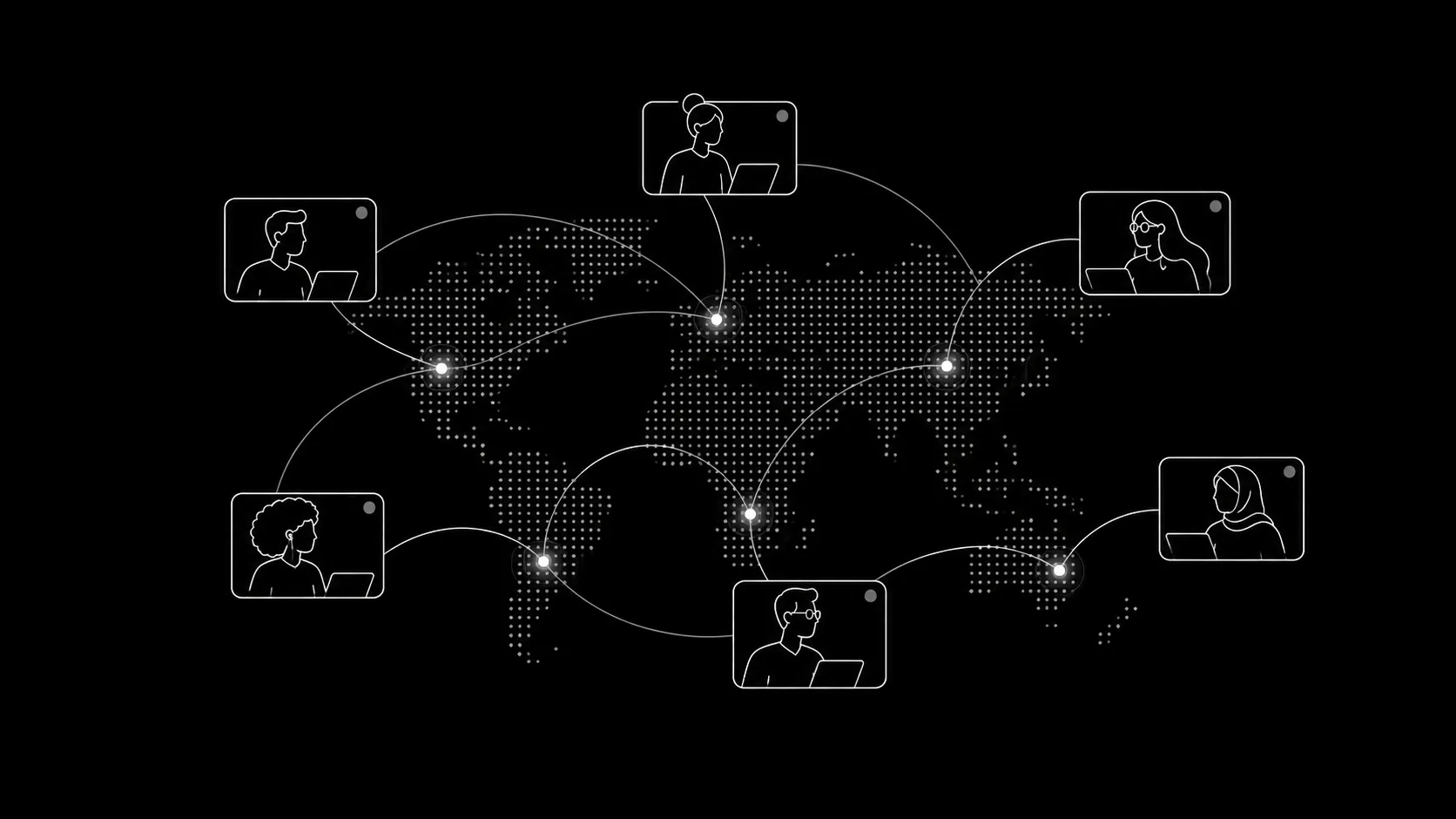
Remote work is not just about moving office meetings to Zoom. True remote work relies heavily on asynchronous communication and rigorous documentation.
When working across time zones, assume that any question you ask might not be answered for 12 hours. This constraint forces you to write better issues, clearer RFCs, and more comprehensive pull requests.
I’ve spent seven years building products with people I rarely saw in person — across 10+ timezones, from a crypto multisig team split between Europe and Asia to my current solo operation running this site and several Telegram bots from Southeast Asia. Along the way I lived in 67 countries, which is a roundabout way of saying: I’ve tested remote work under almost every condition, including a dial-up-speed connection in a van in Kyrgyzstan.
This is what actually works.
Async-First Is a Discipline, Not a Tool
Everyone says they’re “async.” Then you look at their Slack and it’s a wall of “quick question” pings and unresolved threads. Async-first means something stricter:
- Every decision produces a written artifact. Rule in my teams: a decision must be recorded within 24 hours of being made — in the issue tracker, in an RFC, or in the project doc. If it isn’t written down, it didn’t happen.
- Default to channels, not DMs. Direct messages are where context goes to die. Ask in public channels so the answer is searchable for the next person.
- Response-time expectations are explicit. Ours: same business day for blockers, 24–48h for everything else. Nobody is expected to be online. That removes the anxiety theater of green dots and “just checking in.”
The 24-hour rule sounds bureaucratic until the first time a new hire finds a three-month-old RFC that explains exactly why a decision was made. That’s when it pays for itself — usually within the first month.
Writing Issues People Can Actually Execute
When your teammate wakes up 12 hours after you went to sleep, a vague issue costs you a full day. So I write every issue like the assignee can’t reach me:
- Context in two sentences. What is broken or what we’re building and why now.
- Reproduction or reference. A link, a log snippet, a screenshot, a competing product that already solved it.
- Definition of done. Not “make it faster” — “p95 build time under 90 seconds on CI.”
- Explicit non-goals. The single most underrated line. “Do not refactor the parser in this PR” has saved me more review cycles than any linter.
RFCs get the same treatment: problem, constraints, two or three options with real tradeoffs, a recommendation, and a deadline for comments. If nobody objects by the deadline, the recommendation stands. No meeting required.
Timezone Strategy: Embrace the Relay
Most people treat timezones as a problem. A well-run distributed team treats them as a pipeline — work moves around the clock like a relay race. But the baton pass only works if the handoff is written.
My rules:
- End every work block with a handoff note. What’s done, what’s next, what’s blocked. Three lines in the issue. The person waking up should be able to start in five minutes.
- Find the overlap and protect it. With 10+ hour gaps you get maybe one hour of shared daylight. Spend it on the things that truly need synchrony: disagreements, architecture choices, hard feedback.
- Never schedule outside someone’s stated hours without asking. “It’s just once” is how you quietly burn people out.
Handoff template I still use:
Done:  schema migration deployed to staging
Next:  backfill job — ready to run, needs approval
Blocked: API quota bump (ticket #4821, waiting on vendor)
Documentation as the Default
If a piece of knowledge exists only in someone’s head, the team doesn’t have that knowledge — it has a dependency. Documentation covers three layers:
- Decisions — RFCs and issue threads. Why, not just what.
- Process — runbooks for anything done more than twice: deploys, rollbacks, incident response, onboarding.
- Context — the project doc that answers “what are we doing and why” for someone who joins at 2 a.m. their time.
Docs rot, so docs get owners and review dates. A runbook nobody has run in six months is a liability, not an asset.
Meetings Are Exceptions
Synchronous time is the most expensive resource a distributed team has, so spend it like money. My bar for a meeting:
- There’s a decision to make that writing failed to resolve.
- There’s an agenda posted in advance.
- Everyone who can’t attend can still contribute — comments collected beforehand, notes and a recording after.
Everything else is an async update. A “weekly sync” with no decision on the agenda is a calendar habit, not a meeting. Kill it.
The Tooling Stack, Minus the Cargo Cult
Tools matter less than the norms around them, but here’s what survived my last few setups:
- Linear for issues — fast, opinionated, forces a paper trail.
- Notion for docs and RFCs — mediocre editor, excellent shared memory.
- Slack for chat — with aggressive channel discipline and most notifications off.
- Loom for walkthroughs — a three-minute screen recording replaces a 30-minute call.
- GitHub — PRs as documentation; the description explains the why, not the what.
The stack is boring on purpose. The failure mode isn’t picking the wrong tool — it’s having the same conversation in four of them.
Remote-First vs. Remote-Friendly
“Remote-friendly” means remote workers are second-class citizens: decisions happen in the office and get broadcast afterward. “Remote-first” means every process assumes nobody shares a room — hiring, reviews, planning, celebrations. If your promotion path requires being seen in an office, you don’t have a remote culture; you have an office with webcams.
The test I use: if the HQ office burned down tomorrow, would anything about how decisions get made actually change? If yes, you’re remote-friendly.
The Loneliness Problem
This is the part engineering blogs skip, and it’s the main reason remote people actually leave jobs. Fixes that worked for me and people I’ve managed:
- Coworking, always. Every long-stay country on my map has a “my” coworking space. Routine is a feature.
- Non-work channels. Pets, food, local meetups. Ours outlasted two company pivots.
- Quarterly in-person time when it matters. One week of face time buys roughly a quarter of trust. Spend it on design sessions and dinners, not status updates.
A Checklist That Survived Seven Years
- Decision recorded within 24h
- Issues written for someone who can’t ask you questions
- Handoff note at the end of every work block
- Meetings only with agenda + decision + recording
- Docs owned and review-dated
- At least one non-work channel alive
- Overlap hours spent on disagreement, not status
Remote work isn’t a perk or a location policy. It’s an operating system — and like any OS, it’s judged by how well it runs when nobody’s watching.

More from the blog
Living Between Time Zones
What 67 countries and four home bases teach you about deep work, jet lag, and building products nobody asked you to build.
Anatomy of a Modern Engineering Post on y7.hk
A stress test for the y7 reading engine: callouts, diff blocks, KaTeX formulas, a circular avatar video, figure galleries, spoilers, and a font switcher.